Total Pageviews

Showing posts with label Japan. Show all posts

Monday, May 30, 2011

Dr. Koji Yasuda: Connecting Veterinary Medicine in Japan and America

Donald F. Smith (Cornell University)
Posted May 30, 2011

CAREERS FOR VETERINARIANS Series

When Koji Yasuda received his DVM from Cornell last weekend, he joined his father and older brother, Junya, as a family committed to advancing veterinary medicine in both Asia and America. 

Koji (L) and Junya Yasuda relax after Koji received his DVM
 from Cornell University May 29th, 2011. Photo by author.

Koji’s father, Hidemi Yasuda, owns one of the most progressive small animal practices in Tokyo, and also manages a dermatology (IgE) diagnostic service (Spectrum Lab Japan) that employs four staff and receives over 10,000 samples per year from 4,500 veterinarians throughout the country. 

Junya (L) and his parents, Dr. Hidemi and Mrs. Sanae Yasuda.
Yasuda Veterinary Clinic, Tokyo, Japan (2010). Photo by author.

Junya, who already has a college degree in history, is in the process of finishing his veterinary education in Tokyo. Though he has been to the United States multiple times, he has decided to remain in Japan and ultimately take over the family business.

Koji, on the other hand and with his family’s full support, decided to make his career in the United States. He left home at age 15, attended a boarding school in New Hampshire. After receiving his BS and MS from Cornell, he became one of the relatively few international students to receive a DVM from Cornell.

Koji recently received his green card (signifying permanent resident) from the United States Citizenship and Immigration Services, and now embarks on a comparative pathology residency at the New England Primate Research Center at Harvard Medical School in June. With his commitment to the concept of the “One Health” advancing both human and animal medicine, he plans to establish a career in comparative pathology at either a veterinary or medical school setting.

Dr. Smith invites comments at dfs6@cornell.edu.

Tuesday, November 23, 2010

A Successful Pet Insurance Company in Japan

I got an unexpected primer in Japanese pet insurance from one of the veterinarians who attended my November lectures in Tokyo. Dr. Asako Shimamura, a 2002 graduate of the Nippon Veterinary and Life Sciences University, introduced herself as an employee of Anicom Holdings, a growing pet insurance company that markets exclusively in Japan. http://www.anicom-sompo.co.jp/

In discussions with Asako, and also with Tokyo veterinarians who have benefited from her expertise, I became intrigued by the recent success of her company. From a very small beginning in 2000, they now have more than 60% of the domestic market share for pet insurance in Japan.

When I asked Asako to explain her company’s success, she said, “Many people now regard pets not just as companion animals, but as members of the family. Because of her company’s vision―An insurance group aiming to lessen tears and brighten smiles―Anicom is on the march, with sales tripling to over 9B Yen ($110m US) in the last five years.

Sunday, November 14, 2010

Tokyo: A Successful Veterinary Clinic in a Highly-Competitive Environment

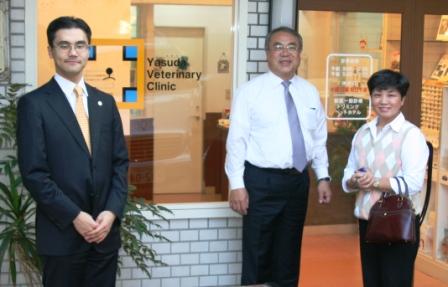
While in Tokyo last week, I visited a small animal practice in the upscale Meguro Ward area in the southern part of the city. “There are over 60 clinics within a three-km radius of our hospital,” noted 58-year-old Dr. Hidemi Yasuda, who established the practice in 1982. “Our patient population is about 70:30 dog to cats, with an occasional ferret or rodent.”

Exterior Entrance to Yasuda Veterinary Clinic: Dr. Hidemi Yasuda (center)
with Junya (left) and Mrs. Sanae Yasuda.
Touring the well-groomed facility, I was struck by the efficiency of the operation and the ardor of the staff doctors and their support team. I asked Dr. Yasuda his recipe for success in a highly-competitive environment where clients arrive in a BMW or Mercedes-Benz and expect what he termed ‘better service’.

Hidemi thought for a moment. “The quality of our employees is critical to our success. From Nanayo Hashimoto in our front office to the veterinarians who are responsible for the medical care of the 60 patients who arrive each day, we provide dignified, individualized service for each client and their pet. This is a passion that was ingrained in me during my first job after graduation, when I worked for a pharmaceutical company.”

Thursday, November 11, 2010

Dr. Gen Kato, the Father of Veterinary Textbook Translation in Japan

Visiting a modern small animal hospital in Tokyo in early November, I marveled at how far the Japanese veterinarians have progressed in the medical care of companion animals in recent years. And one of the reasons for these advances is evident on the book shelves in veterinary offices where I see frequently-used copies of the most influential veterinary textbooks translated into Japanese.

 
Dr. Gen Kato and his technician in front of his CT scan machine

It wasn’t always so,” 78-year-old Dr. Gen Kato, explained to me. “When I opened my first small animal practice in 1964, I did not know how to diagnose and treat many of the problems of the dogs and cats presented to me because our veterinary education in those days was mostly limited to large animals.

Sunday, November 7, 2010

An Interview with a Japanese WW II Veterinary Officer

We were only informed that we were heading south, and it was not disclosed how many days it would take to reach our destination.” So began the five-year war journey of a young Japanese veterinary officer in December 1941, as he disembarked from a port in occupied China with 300 horses under his care.

This afternoon, I had the privilege to interview 93-year-old Dr. Takehiko Takahashi, one of the few remaining veterans of the China-Burma-India conflict. Tall and erect, with a surprisingly facile command of the English language, this distinguished gentleman would later in life become president of the Japanese Small Animal Association. With the assistance of a young Japanese veterinary student named Junya Yasuda, Dr. Takahashi shared with me details of how he transported a boat-load of horses through the South China Sea to Thailand, and from there to the front lines in the jungles and mountains of Burma.
Dr. Takehiko Takahashi, November 7, 2010

The horses were secured in tightly-packed quarters in the ship's hold for the journey. Lack of ventilation and the tropical heat became serious health hazards as they coursed south into the tropical sea. The horses that became sick with respiratory disease were helped by treatment with anti-Strangles serum delivered to their boat while en route. Dr. Takahashi was also successful in convincing the ship’s captain to periodically hoist horses by crane onto the upper deck for fresh air and exercise.

Wednesday, October 20, 2010

Kentucky's Consummate Veterinarian

By Donald F. Smith, Cornell University
Posted December 20, 2010.


This historical blog is in recognition of the 150th anniversary 
of the American Veterinary Medical Association (1863-2013).


As a young man growing up in Kentucky in the 1930s, Delano L. Proctor wanted to be an army officer and a pilot. The Navy rejected him because he was color blind, however, so he followed his father into the veterinary profession. He became a legendary Lexington equine veterinarian, serving some of the best stables in the world’s equine capital.

D.L., as he was affectionately known to his colleagues, joined the service following his graduation from Cornell in 1942. The Army wisely took advantage of his expertise with horses and assigned him to Fort Reno, Oklahoma, the country’s largest remount station, with 5,000 mules and 10,000 horses. He traveled from there to Calcutta, then to India’s embarkation point for the rugged China-Burma-India campaign. His responsibilities were to break, condition, and assure the health of horses and mules used behind enemy lines in the severe jungle and mountain terrain.
Dr. Proctor with a massive bull elephant that he and two colleagues killed.
The state's wildlife warden had ordered it destroyed after a week-long rampage
that had left 35 residents of their village crushed and killed by the rogue beast.

Following his discharge at the rank of Captain in 1946, D.L. returned to Lexington and took over his father’s equine practice. For over 40 years, Dr. Proctor was veterinarian for some of the finest equine stables in Kentucky. The quality of his surgical knowledge and abilities was affirmed when he was admitted, by examination, as one of the early diplomates of the prestigious American College of Veterinary Surgeons. He also served as the 107th president of the AVMA in 1985-86.

Dr. Proctor had a deep respect for his alma mater, “Cornell did great things for me and, above all, there’s the prestige that you get from being associated with it.” While serving as dean, I had the privilege of sharing several lively and insightful conversations with him. Despite debilitating arthritis in his later years, he hired a private airplane so that he could join his remaining classmates for their 65th reunion in 2007.  A modest man who spoke sparingly of his own war experiences, he preferred to acclaim the horses and mules that helped turn the tide in the rugged Burma conflict.

In December 2007, I drove through the snow-covered roads of West Virginia to interview Dr. Proctor for the Enduring Legacy project. He spoke of the greatness of the veterinary profession, and his fondness for Cornell. In his later years, D.L. had become an impressive student of veterinary history, writing insightful (but sadly, unpublished) essays on comparative medicine and early veterinary scholars. When I asked him why he had become so interested in history, he said simply, “Well, it just seems to me like you ought to know where you’re coming from.

D.L. knew better than most where he came from, and also where the profession is going. When he departed this life in 2009, he left a legacy as the complete, the consummate equine veterinarian.

A Biography and interview (audio and transcript) of Dr. Proctor is available on the Enduring Veterinary Legacy series.

Saturday, October 2, 2010

Stephen Ettinger, DVM Honored with Prestigious Salmon Award

When Dr. Stephen Ettinger was presented with the very prestigious Daniel Elmer Salmon award by Cornell alumni on October 2, 2010, he gave an unusual acceptance speech. Rather than talk about the extraordinary achievements as a veterinary cardiologist, scholar and author that have made him the most recognized name in contemporary veterinary medicine, he chose instead to honor the man for whom the award is named.


Dr. Ettinger (right) with his former professor
and mentor, Dr. Robert Kirk (2008).
Dr. Ettinger began his presentation by holding up an egg, symbolic of the recent illnesses that have brought fresh attention to the challenges that we continue to face in preventing food-borne organisms from Salmonella and other contaminants. He then talked about Cornell's first DVM graduate, Daniel Salmon, one of the most renowned veterinarians of the 19th century. Ettinger talked about Salmon's inaugural leadership of the federal Bureau of Animal Industry that was created in 1884, and how he developed a system for food inspection that continued well into the 20th century. He also talked about Salmon's scientific relationship with another Cornell graduate, Theobald Smith, with whom he made many discoveries, including isolating the organism that bears his name: Salmonella.

During the Salmon era, human and veterinary medicine worked side-by-side to achieve great accomplishments in advancing animal and human health. Sadly, the professions drifted apart in the early years of the 20th century.