Total Pageviews

Showing posts with label Women Leadership. Show all posts

Wednesday, March 18, 2015

Are There More Creative Options for Diversifying Academic Leadership?

Donald F. Smith, Cornell University
With Julie Kumble

During a presentation on Women’s Leadership at the AAVMC meeting last week, we confronted the issue of the slow increase in appointments of women to professorial and senior academic leadership positions over the past three decades despite vigorous affirmative action policies in the academy. “Can we learn some lessons from the successful increase in women’s leadership in places like the Iowa Veterinary Medical Association (IVMA),” we asked, “or are we going to continue the glacial pace of improvement that characterizes many of our universities?”

As we reported in a posting here last year, the IVMA, led by Dr. Tom Johnson, didn’t just increase the depth of the candidate pool and help people understand and support a broader understanding of gender diversity, they also fostered institutional change. By modifying the very basic parameters of office-holding, they increased the pace of change.(1) “Our leadership profile didn’t just happen,” Johnson told us during our 2013 interview.

Instead, they used a multi-pronged approach. One was familiar to all of us, and involved developing leadership training opportunities for the target audience of women and new graduates. The other initiative was bolder: they made substantive institutional changes in the association. 

Of the several structural changes they instituted, we mention just two. One was to institute term limits, thereby opening up opportunities for more people to have a chance at leadership. Second, they confronted the prevailing dogma that leadership required progressively more challenging appointments, moving sequentially up the ladder one rung at a time to attain the necessary qualifications through experience, rather than a combination of experience AND creative mentoring PLUS targeted educational opportunities.

How has veterinary academia fared in the thirty-plus years since we have seen over 50% women enter our US colleges? In the last five years (2010-2015), the increase in tenure track professorial positions at all levels has only changed from 32% to 34%. The increase in faculty administrators, from 25% to just 34%. The percentage of women in all faculty positions in our 30 colleges ranges from 15% to 49%. Clearly, not what any of us wants.

Is it time to consider a bolder approach?

How about the following:

Ø  Term limits for deans, associate and assistant deans, department chairs and directors: four- or five-year terms, renewable no more than once. In addition to ensuring more frequent turnover of people in the most senior administrative offices, it would also allow colleges to prepare two or three years in advance of the appointment, rather than just months in advance. Though most dean searches are conducted over 12-14 months, the actual period of inviting people to become candidates is often a mere four months.(2) By extending opportunities for inquiry, recruitment and extended visits to one year or longer, the potential for active consideration of inspiring candidates could increase exponentially.

Ø  What about changing these job descriptions to accommodate greater flexibility for high quality candidates with diverse portfolios? Do all deans need to be internationally-recognized research scholars? Perhaps we need a less constrained concept of scholarship, one that reflects the future needs of society rather than the traditional needs of the academy. Do all deans need to be expert fundraisers, constantly on the move from meetings a mile away with vice presidents for development, to meetings a continent away with potential donors? Do we ever really assess the investment of international travel on time away from our offices and our families? Do deans really need to spend four hours a week in face-to-face meetings with provosts and vice presidents? Is it time to say “no” to the unending reports that keep deans from the important work of meeting with students and faculty, and from their children? Accountability is important, but so is trust and a lighter hand on university centralization. Is it time for deans to return to becoming academic leaders more, and managers of centralized university units less?

“Can’t be done,” some would argue, “because of federal and state regulations, the tightening university grip, and a myriad of other challenges.” Perhaps. But with an added measure of creativity, open minds, and our collective ability to problem solve, we might be able to make the type of progress that our colleagues in organized veterinary medicine have already been able to accomplish.

And by doing so, we could really increase the richness and diversity of the potential applicant pool. Now, THAT would be affirmative action, and perhaps the graphs would more accurately reflect the face of veterinary medicine in 2020.


(1) Smith, Donald F. and Julie Kumble. Veterinary Leadership in Iowa. Perspectives in Veterinary Medicine, December 12, 2013.
(2) The additional time is spent for provost to meet with stakeholders, for the search committee to be established, and for the position description to be written and advertised. Following the assembly of a cohort of applicants, the final several months are devoted to interviews, selection, and negotiation.


Saturday, March 8, 2014

Stories of Women Veterinarians


By Donald F. Smith
March 8, 2014 (International Women’s Day)

March is Women’s History Month. For veterinarians, it provides an opportunity to pause and reflect on the challenges women faced in gaining access to the profession until the mid 1970s; and the challenges they face even to the present to be involved sufficiently in the leadership of profession.

For the past year, I (and others) have written extensively on the subject of women veterinarians in general, and women’s leadership, more specifically. Here is a listing and brief overview of some of these stories in the hope that his repository will serve as an inspiration to women and men alike. 

Stories of Individual Women in the Early Years of the Profession through the 1960s

One of the early women to receive a DVM was Joanna Asmus, Cornell class of 1929. She was the daughter of the university’s farrier, a post that was held in very high distinction in that period. This story was researched and written by a veterinary student, Michelle  Pesce ’12.

Cornell admitted three women in 1935. Though it was during the depths of the Depression, this was the most women of any single class to that date. There was reluctance on the part of some faculty to admit women feeling that they were taking the place of a man who could be a family breadwinner. Nonetheless, the women were well-integrated with the 37 men, most of whom considered the women valued members of the Class of 1939. Each of these women had careers in clinical practice. Two also developed alternative pathways, one in zoo animal medicine (Halloran) and the other (von Decken Luers) in regulatory work in the Virgin Islands. Here are their stories.

Additional descriptions about life during the Depression can be found in a series of four stories at www.veritasdvmblog posted November 13, 14, 16 and 17, 2013.  Though none of these stories are about women, per se, they give the reader a sense of how challenging life was during that period and how precious a commodity a veterinary degree was for young people of either gender.

The University of Pennsylvania admitted its first woman in 1934. Josephine Deubler VMD, PhD led a remarkable career in teaching and research. An avid dog breeder and judge, the capstone of her career (in her words) was having the privilege to judge Best in Show at the 1998 Westminster Kennel Club show in Madison Square Garden.

During the 1950s and 1960s, it was common for veterinary classes to hold two seats per year for women. Admission committees would review all of the male candidates, then select a small group of women candidates for interview. Occasionally, a class would have three or four women, as in the Class that started at Cornell in 1956, of which Dr. Carolyn Comans was a member. Five years later, Dr. Linda Reeve Peddie was the only women in her Cornell class.

Stories of Women’s Leadership in Organized Veterinary Medicine

Dr. Eva Evans graduated less than two years ago from the University of Tennessee. Despite her busy life in clinical practice, she has already become involved with the American Veterinary Medical Association (AVMA) as a member of the Political Action Committee. She is considered a role model and mentor for other young women seeking to influence the profession through organized veterinary medicine.

Though still a relatively early career veterinarian, Dr. Karen Bradley is a well-respected veterinarian and one of the most influential women leaders in the profession. She is founder and president of the Women's Veterinary Leadership Development Initiative. Here is the story that I call simply, “Five Days in July”.

Dr. Andrea Dennis-LaVigne will assume the presidency of the Connecticut Veterinary Medical Association this spring. She is deeply involved not only in the veterinary profession, but also in community service, most notably as a governor appointee to the Board of Trustees of the University of Connecticut.
                                               
Dr. Linda Tintle is a practice owner in the northeast who has served as her state’s association president. She is a strong advocate for practice ownership, as she emphasizes in this story from last August.

Through changes in policy and creative educational opportunities, Iowa Veterinary Medical Association advocates and promotes women and recent graduates to leadership position in its state organization. Some of their programs are jointly administered with Iowa State University.

At a national level, the profile of AVMA leadership positions demonstrates an unequal representation of women amongst the colleges of which they are alumnae.  Some colleges, notably Iowa State University and Washington State University have alumnae in greater numbers than colleges like University of California, Davis, or the Ohio State University, among others.

Stories of Women Deans in Veterinary Medicine

Though our student population has been over 50% female for almost three decades and now exceeds 80% at many colleges of veterinary medicine―the national average is 78%―there are only six women deans in the US (20%, similar to US Congress).

One of the great thrills of writing about leaders is interviewing them and finding out what makes them so successful, while recognizing that they are most often ordinary people doing exceptional things in an extraordinary way.  Here are the stories of two deans, Dr. Sheila Allen (University of Georgia) and Dr. Eleanor Green (Texas A&M University).

Not surprisingly, the deans credit mentors as one of the significant reasons for their success as veterinarians and as academic leaders.

Women’s Veterinary Leadership Development Initiative, and Courses in Women’s Leadership

The Women’s Veterinary LeadershipDevelopment Initiative (WVLDI) has sponsored and organized several educational programs in the last few months, and has exciting plans for the next year. Sponsors include the AVMA and CEVA Animal Health.

A successful women’s leadership development course for students at Cornell was held on March 1. Thirty-five first-, second- and third year students attended the six-hour Saturday program, with guest speakers from New York, Massachusetts and Connecticut.

Participants in the First Student Course for Women's Leadership,
held at Cornell University on March 1st. Instructors in the middle of the front row are
Linda Tintle DVM, Julie Kumble MEd, Susan Wylegala DVM, and Andrea Dennis-LaVigne DVM
(Photo by the author)
With acknowledgement and thanks to the Women’s Veterinary Leadership Development Initiative, led by Drs. Karen Bradley (President), Stacy Pritt (Vice President), and Douglas Aspros (Secretary-Treasurer); and the rest of the directors. 

Dr. Smith can be reached at dfs6@cornell.edu

Wednesday, November 28, 2012

Women's Leadership in the U.S. Congress and the AVMA's House of Delegates: Exploring Parallels and Looking Forward

By Julie Kumble*, Guest Author
with Donald F. Smith, Cornell University
Posted November 28, 2012

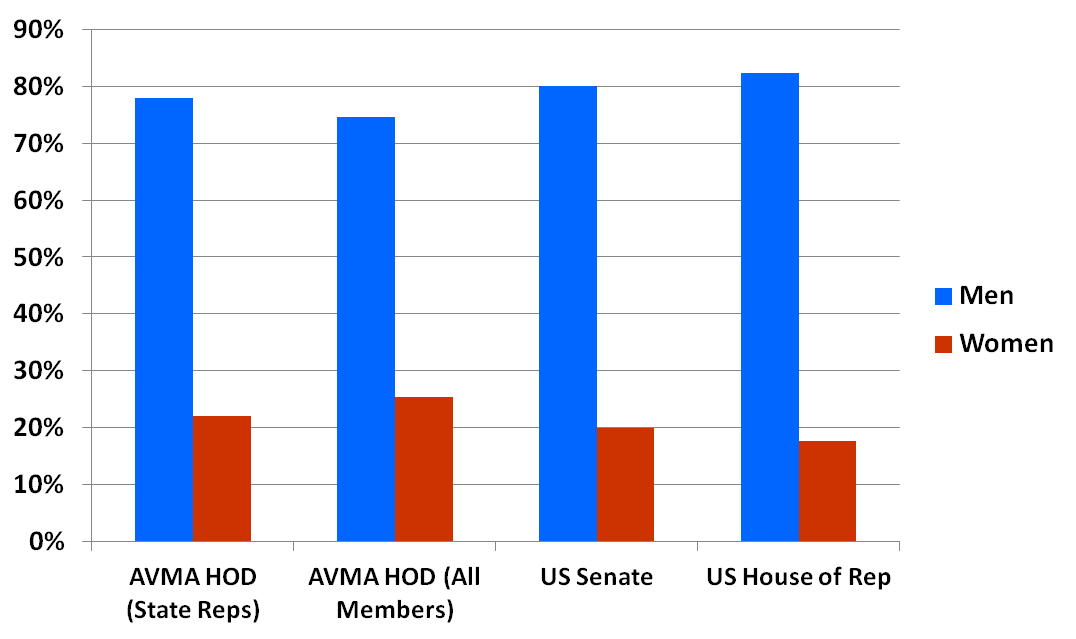
As veterinarians watched the election returns on November 6th, most eyes were on the top of the ticket or on specific congressional, state or local races. However, something else was happening as the election of women to Congress reached historic proportions. For the first time, the Senate will have 20 women (an increase of three), and the House of Representatives will reach 17% women.

Julie Kumble, 
guest author
What was particularly fascinating to us is how closely the gender distribution in the 113th Congress will approximate the number of women representatives in the House of Delegates (HOD) of the American Veterinary Medical Association (AVMA).

The HOD is the AVMA's principal governing body and consists of 52 delegates, one from each state including the District of Columbia and Puerto Rico; plus 14 members from professional associations like the specialty, species and career-based organizations. For each delegate, an alternate is also a sitting member of the House. 

Only delegates (not alternates) can vote within the HOD, and their votes are weighted proportionate to the population of their respective states. For example, California has 47 weighted votes and Texas has 41. At the other end of the population scale, Wyoming and Vermont have four and five weighed votes, respectively. The allied groups each have two weighted votes.

This graph shows the gender proportions in the newly-elected 113th Congress compared to the 2012-13 HOD. We further segmented the data in the first two columns for those HOD delegates and alternates who are state representatives (104 total) from the total number of delegates and alternates that includes those representing other organizations (134 total).


Percentages of Women and Men  in the 113th US Congress
and in the AVMA's House of Delgates

The proportions of women in the HOD and in Congress are entirely consistent with other sectors, from academia to business to politics, where women hold only an average of 18% of the top leadership positions. However, women earn 57% of college degrees, with most of the gains above 50% being achieved in the last decade. Women have been more numerous that men in veterinary colleges since the early 1980s, and have earned over 80% of veterinary degrees for almost 20 years.


The following graph shows the relative age distribution of delegates and alternate delegates for the HOD, using graduating year as an rough proxy for age. The mean year-of-graduation for each cohort is shown on the y-axis. For example, the mean year-of-graduation for all HOD delegates is 1979 (33 years ago). For women, the mean year-of-graduation is 26 years ago (1986). Male delegates on the other hand are older, with their mean year of graduation being 35 years ago (1977). 

Not surprisingly, the alternates who represent the more recently-appointed HOD members are more likely to be younger. That age difference is seen in men as well as women.


Distribution of House of AVMA's House of Delegates
by Year of Graduation
Experts recommend a minimum of 30% women for leadership positions in any sector to achieve a critical mass where women’s roles become part of the norm of that sector. The Wellesley Center for Women considers that proportion to be the minimum needed for change at the governance and top levels.  With the total population of women veterinarians now over 50% and growing more rapidly than any other major profession, it is even more important to establish institutional frameworks to assure that the number of female HOD delegates and alternates reach and maintain at least the 30% critical mass as soon as possible.


Karen Bradley, DVM
Delegate and Chair,
House Advisory Committee
Dr. Karen Bradley is the current HOD delegate from Vermont and also currently serves as the chair of the House Advisory Committee. This is a group of seven members who act as the executive body for the HOD.  As the leading member of the HOD and also the owner of a four-doctor veterinary practice, Bradley has the opportunity and the responsibility to look ahead and consider the changing demographics in our profession from a leadership point of view. 

She comments: "How states and allied groups identify HOD members varies greatly. Some states have many people waiting in line for their turn as a delegate, and others have to seek out people for the position.  Some states even have a formal election from their membership.  Though the Manual of the House of Delegates states that the term for delegates and alternates is four years, there is no limit to the number of terms imposed by the Bylaws nor the Manual.  Without term limits, delegates can remain in office for decades.  


"I am very fortunate to be in Vermont, a state with very active women veterinarians--and men willing to share the table.  Our state VMA's Executive Committee has been approximately 50% women for the last 10 years whereas 20 years ago it was similar to the HOD and Congress with 20% or fewer women.  What did Vermont do to effect this change?  It seems that in our small state, the veterinarians active in organized associations tended to bring in new blood more frequently.  After serving for a number of years they would seek out new recruits for committees and leadership positions and those happened to be women more and more as the population of veterinarians in Vermont became more female.  And for what it’s worth, Vermont's AVMA HOD delegation over the last 20 years has been four women and two men! " 
Looking ahead and considering the changing demographics in our profession, we will do well to encourage more women to run as delegates, to mentor younger female veterinarians and encourage them to take on leadership roles, and to serve as role model to other professions by striving to achieve and surpass the critical mass point of 30% in the House of Delegates.

Dr. Smith invites comments at dfs6@cornell.edu

*Julie Kumble is Director of Grants and Programs, Women's Fund of Western Massachusetts
Easthampton, Massachusetts 01027. She can be reached at juliek@womensfund.net. 

Photo credits: 
Julie Kumble's photo provided by Women's Fund of Western Massachusetts
Karen Bradley's photo provided by the American Veterinary Medical Association