Total Pageviews

Friday, February 7, 2014

Dr. Andrea Dennis-LaVigne to Become President of the Connecticut Veterinary Medical Association

By Donald F. Smith, Cornell University
Posted February 7, 2014
Recognizing Women's Leadership in Veterinary Medicine and Honoring Black History Month

An expanded version of this story was posted in Feb 10th at   http://veterinarylegacy.blogspot.com/2014/02/dr-andrea-dennis-lavigne-to-become.html

     
      "It's a great conversation piece," Dr. Andrea Dennis-LaVigne says of President Obama's personal note and signature on a poster in the Bloomfield Animal Hospital, the hospital she began 20 years ago just north of Hartford, Connecticut.

During a visit to the White House, Dr. Dennis-LaVigne
received an autograph and personal greeting from 

President Obama and Bo
Photo provided by Dr. Dennis-LaVigne.
      Dr. Dennis-LaVigne grew up in Connecticut, the oldest of three girls, raised by a single mother who taught her to be industrious and self-sufficient. At the age of 17 she went off to Cornell, but the racial tension she found there in the early 1970s proved too much for this young African-American woman, and after one year she transferred to the University of Connecticut where she continued to pursue her undergraduate degree.
      Andrea had wanted to be veterinarian since childhood, but her advisor at UCONN told her, “You’ll never be a veterinarian.” Undaunted, she switched advisors, applied as a junior and started veterinary college in 1978. She almost didn’t accept the offer from Tuskegee ―“George Wallace was governor, I can’t go there,” she said―but her advisor encouraged her, telling her to just go and she’d be fine in Alabama. He insisted that she would fulfill her dream of becoming a veterinarian and, by matriculating as a junior, would even save a year of college and tuition. “One person believed in me,” Dr. Dennis recalls sentimentally. “One person believed in me.”
     She had a wonderful time in Tuskegee. “It was a small school and the Dean, Dr. Walter Bowie was great, and everyone was a mentor. Everyone had my back.” 
      After graduation, Dr. Dennis completed an internship in large animal medicine and surgery at the University of California, Davis, then taught for a year at the newly-opened Ross School of Veterinary Medicine. Ross was still located on the island of Dominica when she started, and she actually experienced the move to the island of St. Kitts.
      But after the year, she decided to go into practice back in the Northeast and, for the next eight years, worked in two small animal practices. While she learned a great deal observing how these owners ran their practices, she yearned to start her own business.

      So in 1992, she started out on her own. Using a house that she co-owned with her mother as collateral, she borrowed $100,000 from the bank and acquired a wonderful array of used equipment given to her by the the local hospital to complement new equipment purchases. Even in her first year, the business at her Bloomfield Animal Hospital business was above expectations and she has never looked back. In 1997, she was joined by Dr. Eva Ceranowicz and together they have built a thriving practice with a diverse and supportive clientele.


Dr. Andrea Dennis-LaVigne and her associate, Dr. Eva Ceranowicz
Photo provided by Dr. Dennis LaVigne

      Dr. Dennis-LaVigne is passionate about giving back and supporting her community. She has held many leadership positions at her undergraduate alma mater, the University of Connecticut, and currently serves on it Board of Trustees. In 2011, she gave the commencement address for the university in front of some 8,000 graduates, family members and friends.

      A firm believer in organized veterinary medicine, Dr. Dennis-LaVigne will become the sixth woman president since 2000, of the Connecticut Veterinary Medical Association. Just as she was the first African American veterinarian in Connecticut, she will also carry that distinction to the presidency. 

I thank Ms. Julie Kumble, Interim CEO, Women’s Fund of Western Massachusetts, Easthampton, MA 01027, for arranging an interview for the two of us with Dr. Dennis-LaVigne on January 28, 2014. The information in this blog is based upon that interview to support our ongoing research in women's leadership in veterinary medicine.


Thursday, August 29, 2013

Check out my New Blog at www.VeritasDVMblog.com

Posted August 29, 2013

Donald F. Smith DVM

Please explore my new blog, Perspectives in Veterinary Medicine, produced in conjunction with Cornell and Texas A&M Universities, and Zoetis.  

In celebration of the 150th anniversary of the American Veterinary Medical Association, I am posting this series of stories to chronicle the events that have contributed to the way the veterinary profession functions today. This is all with an eye to the future, helping us anticipate what comes next in our profession.

Regular readers of this blog will see some overlap but most stories are new and more detailed, with more references and footnotes.

I am deeply appreciative of the almost 100,000 "reads" that you have provided over the past three years. You have been my most loyal support base and I deeply appreciate your readership.  It is my hope that you will also join me now at Perspectives in Veterinary Medicine.

As always, you can reach me at dfs6@cornell.edu.


With all good wishes, Donald Smith.

Monday, January 21, 2013

Frederick Douglass Patterson and Tuskegee's School of Veterinary Medicine


By Donald F. Smith, Cornell University
Posted on January 21, 2013, in honor of Martin Luther King, Jr. Day

African-American veterinarians have played a special role in animal care and public health since the early days of the profession. The most notable of the approximately 70 African-Americans who received their DVM degrees during the first half of the 20th century is Frederick Douglass Patterson. Orphaned shortly after his birth in 1901 and raised by his sister in Texas, Patterson received his veterinary degree at Iowa State University and later his PhD from Cornell. He became the third president of Tuskegee Institute in 1935 as the south was moving from cotton plantation agriculture to raising livestock.

Overcoming enormous challenges, Patterson developed a veterinary college for African-Americans at a time when higher education in the South was segregated and there were only 12 other veterinary colleges in the country.

To people outside of the veterinary profession, Patterson’s most memorable achievement was organizing fellow Historic Black College presidents to form the United Negro College Fund in 1946. He was also instrumental in establishing the Tuskegee Airman program during his tenure as university president.

Dr. Eugene W. Adams,
Author of "The Legacy"
A History of The Tuskegee University
School of Veterinary Medicine
(Photo by the author, 2012)
Published on the 50th anniversary of veterinary medicine at Tuskegee, Dr. Eugene Adams' definitive historical book, "The Legacy"  describes Patterson's contributions to Tuskegee and to African-American education in general. 

Dr. Adams received his DVM from Kansas State University and his PhD from Cornell. A distinguished pathologist, Adams served on the Tuskegee faculty for almost four decades.

Concern for public health has always been a feature of Tuskegee’s veterinary program, and many of their graduates have had careers in food safety and research. The college is now even closely aligned with human health because of its unique organizational structure that combines Veterinary Medicine as well as Nursing and Allied Health in the same college. Veterinarian Tsegaye Habtemariam, who jointly administers all of these programs, feels that the unified governance facilitates opportunities for advancing the ‘one health’ agenda by which veterinarians can have a stronger role in promoting the health of people as well as animals.

Two current deans of veterinary medicine in the United States are graduates of Tuskegee: Willy Reed (Purdue University) and Phillip Nelson (Western University of the Health Sciences). Along with another alumnus, Michael Blackwell (dean emeritus of the University of Tennessee) and Tuskegee’s current dean, Dr. Habtemarian, these distinguished educators serve as great role models for young African-Americans who aspire to leadership positions in the health professions. 

Sign at the entrance to Moton Field, named after Tuskegee's
second president and made famous by the
Tuskegee Airmen who trained there during World War II.
(Photo by the author, 2012)
Visitors to Tuskegee's campus are deeply moved by symbols of the African-American educational tradition. An inspiring sculpture of founder Booker T. Washington sits beside the campus chapel and is inscribed by the words, "He lifted the veil of ignorance from his people and pointed the way to progress through education and industry." A few miles from campus is the airfield used by the Tuskegee Airman and made famous by the 2012 movie “Red Tails” and the current off-Broadway play, “Black Angels over Tuskegee".  

For current and future veterinarians of all backgrounds, one cannot consider Tuskegee University or her veterinary graduates without acknowledging the extraordinary legacy of Frederick Douglass Patterson, DVM, PhD, one of the most important veterinarians of the 20th century.

Dr. Smith invites comments at dfs6@cornell.edu


Friday, January 18, 2013

Arizona's New College of Veterinary Medicine


By Donald F. Smith, Cornell University
Posted January 18, 2013

With the appointment last week of a dean of veterinary medicine for Midwestern University, Arizona is moving forward with plans to open the 29th veterinary college in the United States in fall 2014. They have already received a State of Arizona License and are scheduled for a site team by the Council on Education of the American Veterinary Medical Association starting January 20, 2013.

Dr. Brian Sidaway is the
dean of veterinary medicine
at Midwestern University
in Glendale, Arizon
(Photo by Midwestern University)

Midwestern University, a not for profit health sciences university in Glendale, Arizona is home to colleges of osteopathic medicine, pharmacy, optometry, dental health and a large number of master and doctorate programs in its health science college.  When I asked President and CEO Kathleen H. Goeppinger, Ph.D. last year why she would contemplate starting a college of veterinary medicine, she gave one of the most compelling rationales I have ever heard by a senior university administrator.  “Quite simply,” she said, “animals contribute to human health and I felt having a health sciences campus without veterinary medicine would be incomplete.”  Apart from the important role that animals play in supporting human health and well-being, she also pointed to the need to educate more veterinarians to serve in rural areas of Arizona.

At the national level, many practicing veterinarians feel that the 25% growth in the number of veterinary graduates in the last decade has created an oversupply of new veterinarians entering clinical practice. However, Arizona is the second most populous state without a veterinary college (1) and the number of Arizona residents who are accepted each year into U.S. veterinary colleges is among the lowest in the country. Similarly, the number of veterinarians per capita practicing in Arizona is much less than the national average.

When it comes to the vast rural areas in Arizona, the need for veterinarians is especially acute for both livestock and horses, but also for companion animals. Midwestern proposes to accept more students from rural areas with the hope that they will fill that critical need.

Another great unmet need for veterinarians across the entire U.S. is in public and corporate practice. This priority is recognized by former surgeon general Rich Carmona, MD, who lives in Tucson, AZ. Dr. Carmona is a strong supporter of the critical role of veterinarians in public health and he shared the following with me in March last year when the first announcement of Midwestern’s plans were made public.

"During my tenure as United States Surgeon General [2002-06], it became very apparent that veterinarians were essential elements not only to the nation's health, but also to national and global preparedness activities, and as leaders of our multidisciplinary teams.

Veterinarians were some of the most sought-after professionals by all branches of the Federal Government. Whether from traditional veterinary practice to research and development, zoonoses, emerging infectious and global health, we were always in short supply of veterinarians."

Midwestern will be just the fourth veterinary college in the U.S. to be established on a non land-grant campus. Though it will fulfill the need to educate students in species of agricultural interest, its urban location (2) and its educational priorities will also reflect the reality that the overwhelming majority of practicing veterinarians are needed in companion animal practice. These veterinarians not only serve the health needs of the family pet, but also promote the concept of one health for all species because of the positive impact pets have for human health and well-being.

1)  Arizona's population is 6.6 million (2012 estimate). New Jersey, the most populous state without a veterinary college, has 8.9 million people.
2)  Midwestern is located in a metropolitan area of over four million people, one of only four veterinary colleges in the country located in the top 15 metropolitan areas in the U.S. Like Midwestern, each of the other three colleges is located on a campus with other health science colleges (University of Pennsylvania, Tufts University and Western University of the Health Sciences).

Wednesday, November 28, 2012

Women's Leadership in the U.S. Congress and the AVMA's House of Delegates: Exploring Parallels and Looking Forward

By Julie Kumble*, Guest Author
with Donald F. Smith, Cornell University
Posted November 28, 2012

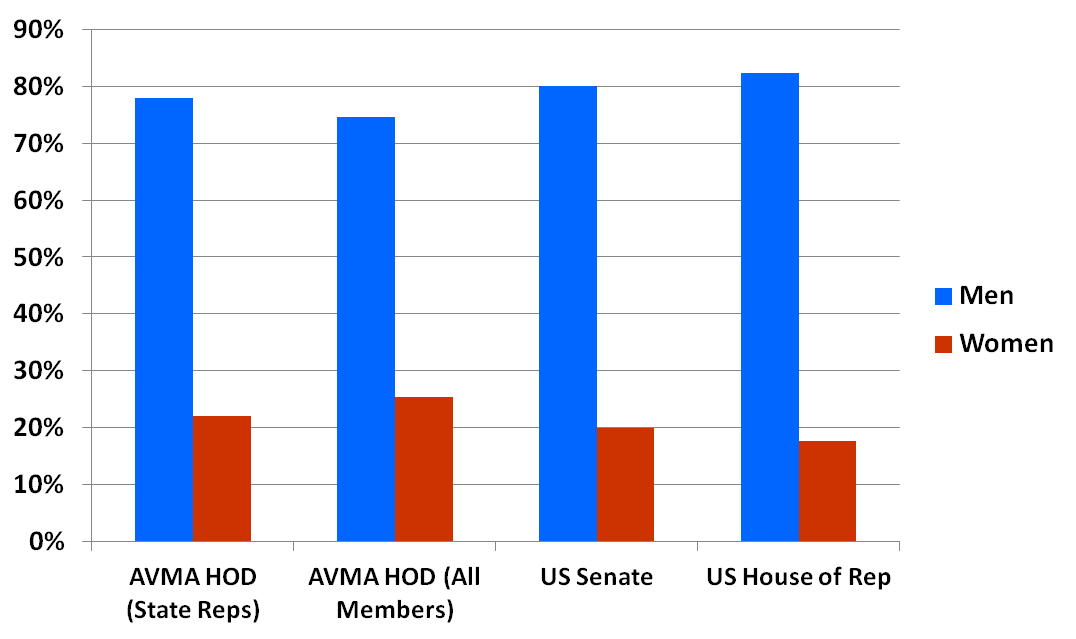
As veterinarians watched the election returns on November 6th, most eyes were on the top of the ticket or on specific congressional, state or local races. However, something else was happening as the election of women to Congress reached historic proportions. For the first time, the Senate will have 20 women (an increase of three), and the House of Representatives will reach 17% women.

Julie Kumble, 
guest author
What was particularly fascinating to us is how closely the gender distribution in the 113th Congress will approximate the number of women representatives in the House of Delegates (HOD) of the American Veterinary Medical Association (AVMA).

The HOD is the AVMA's principal governing body and consists of 52 delegates, one from each state including the District of Columbia and Puerto Rico; plus 14 members from professional associations like the specialty, species and career-based organizations. For each delegate, an alternate is also a sitting member of the House. 

Only delegates (not alternates) can vote within the HOD, and their votes are weighted proportionate to the population of their respective states. For example, California has 47 weighted votes and Texas has 41. At the other end of the population scale, Wyoming and Vermont have four and five weighed votes, respectively. The allied groups each have two weighted votes.

This graph shows the gender proportions in the newly-elected 113th Congress compared to the 2012-13 HOD. We further segmented the data in the first two columns for those HOD delegates and alternates who are state representatives (104 total) from the total number of delegates and alternates that includes those representing other organizations (134 total).


Percentages of Women and Men  in the 113th US Congress
and in the AVMA's House of Delgates

The proportions of women in the HOD and in Congress are entirely consistent with other sectors, from academia to business to politics, where women hold only an average of 18% of the top leadership positions. However, women earn 57% of college degrees, with most of the gains above 50% being achieved in the last decade. Women have been more numerous that men in veterinary colleges since the early 1980s, and have earned over 80% of veterinary degrees for almost 20 years.


The following graph shows the relative age distribution of delegates and alternate delegates for the HOD, using graduating year as an rough proxy for age. The mean year-of-graduation for each cohort is shown on the y-axis. For example, the mean year-of-graduation for all HOD delegates is 1979 (33 years ago). For women, the mean year-of-graduation is 26 years ago (1986). Male delegates on the other hand are older, with their mean year of graduation being 35 years ago (1977). 

Not surprisingly, the alternates who represent the more recently-appointed HOD members are more likely to be younger. That age difference is seen in men as well as women.


Distribution of House of AVMA's House of Delegates
by Year of Graduation
Experts recommend a minimum of 30% women for leadership positions in any sector to achieve a critical mass where women’s roles become part of the norm of that sector. The Wellesley Center for Women considers that proportion to be the minimum needed for change at the governance and top levels.  With the total population of women veterinarians now over 50% and growing more rapidly than any other major profession, it is even more important to establish institutional frameworks to assure that the number of female HOD delegates and alternates reach and maintain at least the 30% critical mass as soon as possible.


Karen Bradley, DVM
Delegate and Chair,
House Advisory Committee
Dr. Karen Bradley is the current HOD delegate from Vermont and also currently serves as the chair of the House Advisory Committee. This is a group of seven members who act as the executive body for the HOD.  As the leading member of the HOD and also the owner of a four-doctor veterinary practice, Bradley has the opportunity and the responsibility to look ahead and consider the changing demographics in our profession from a leadership point of view. 

She comments: "How states and allied groups identify HOD members varies greatly. Some states have many people waiting in line for their turn as a delegate, and others have to seek out people for the position.  Some states even have a formal election from their membership.  Though the Manual of the House of Delegates states that the term for delegates and alternates is four years, there is no limit to the number of terms imposed by the Bylaws nor the Manual.  Without term limits, delegates can remain in office for decades.  


"I am very fortunate to be in Vermont, a state with very active women veterinarians--and men willing to share the table.  Our state VMA's Executive Committee has been approximately 50% women for the last 10 years whereas 20 years ago it was similar to the HOD and Congress with 20% or fewer women.  What did Vermont do to effect this change?  It seems that in our small state, the veterinarians active in organized associations tended to bring in new blood more frequently.  After serving for a number of years they would seek out new recruits for committees and leadership positions and those happened to be women more and more as the population of veterinarians in Vermont became more female.  And for what it’s worth, Vermont's AVMA HOD delegation over the last 20 years has been four women and two men! " 
Looking ahead and considering the changing demographics in our profession, we will do well to encourage more women to run as delegates, to mentor younger female veterinarians and encourage them to take on leadership roles, and to serve as role model to other professions by striving to achieve and surpass the critical mass point of 30% in the House of Delegates.

Dr. Smith invites comments at dfs6@cornell.edu

*Julie Kumble is Director of Grants and Programs, Women's Fund of Western Massachusetts
Easthampton, Massachusetts 01027. She can be reached at juliek@womensfund.net. 

Photo credits: 
Julie Kumble's photo provided by Women's Fund of Western Massachusetts
Karen Bradley's photo provided by the American Veterinary Medical Association


Tuesday, November 27, 2012

Driving with my Dog to Alaska: The Road Home

By Donald F. Smith, Cornell University
Posted November 27, 2012

Five years ago my dog, Beau, and I drove from our home in upstate New York to Alaska and back. The first 15  installments can be found by clicking the "Traveling with Beau" link on the upper right-hand corner of the Home Page.  My wife, Doris, flew into Anchorage and joined us for 10 days. 

Doris flew out of Anchorage on September 3rd, on the last direct Chicago flight of the season. The following day, American Airlines would be rerouting its Chicago plane to San Juan, yet another indication that the north is ephemeral and relatively isolated especially in the winter months.

After leaving the airport, Beau and I retraced our path from Anchorage through Palmer and the Wrangell Mountains to Tok, where we spent our last night in Alaska. We had barely reached Tok when my daughter called with the news that my 89-year-old mother had fallen at a bus stop in Toronto and broken her hip. My plans for a circuitous trip back through the northern Yukon and then south through British Columbia changed, and we headed home by a more direct route, even including the interstate after we reached the United States south of Winnipeg, Manitoba four days later.

We left Tok very early on our second morning and soon crossed the border back into Canada. Though much of the scenery was familiar, the days are much shorter now and the higher elevations in the Yukon were snow-covered. 

On our way through Beaver Creek ten days earlier, I had noticed more than the usual roadside advertising for Buckshot Betty's Restaurant and Cabins. Though I'm not one for silly local fork lore, we were both in need of a breakfast break, so I pulled onto the spacious gravel apron and parked between two large RV's, each with miniature dogs barking at Beau through the closed windows.

I entered a cozy breakfast nook already inhabited by a large table overflowing with a dozen or more people with plates spilling over with pancakes, eggs and sausage. I patiently waited by the door for at least five minutes -- I didn't want to sit down until invited to do so -- when from the kitchen burst a larger than life person who could only be Betty herself, balancing another half dozen plates in one hand and two coffee pots in the other. She ordered me to sit down in the most colorful language I"d heard all trip, and reinforced her admonition with something about her not being my mother. When I told her I wanted takeout because a had my dog in the car, she replied without hesitation to "bring the mutt inside." 

Beau and I had a delightful time with Betty, especially after the RV's left and it was just she and her assistant with the two of us. She is a legend in these parts and, as we left, she tucked a copy of the CD, "The Ballad of Buckshot Betty", under my arm. 


'Buckshot Betty' and Beau in Beaver Creek, Yukon.


Red fox along the Alaskan
highway in the Yukon.
People in the Yukon seemed to be either natives or newcomers. Betty was a native. But at one midnight rest stop in Teslin (Yukon), I found a newcomer when I inquired of her  if the northern lights were often visible during the fall. Looking at me as if she didn't understand the question, I repeated it and said we had seen them in Denali Park. "No," she answered authoritatively, "I've never seen them." 
As I walked back to the jeep, I saw the lights reaching from the expanse of the northwest and hovering almost above me. The multi-colored aurora was visible for the next two hours, so brilliant and beautiful that we stopped several times so I could marvel at the wonder of it all.
Proprietor of the Kluane Museum of Natural
History in Burwash Landing, with Beau

I met another long-timer at the 95-person hamlet of Burwash Landing at milepost 1093 on the Alaskan Highway. We were the sole patrons of the quaint Kluane Museum of Natural History with its interesting taxidermy collection complete with a standing polar bear that stretched to an imposing ten-feet in height. The proprietor, a caustic young man with long hair and beard told me he was originally from Toronto. "How did you get up here?", I asked. "By Greyhound!" was his curt answer, and the conversation deteriorated from there. 


An hour-long wait along the southern stretches of Kluane Lake
due to blasting associated with new construction.

Patience is a must requirement for travel on the Alaska Highway whether encountering long  sections of road with pot holes the size of boulders, or extensive delays due to construction and the never-ending maintenance associated with extreme frost upheaval that occurs during the long winter months. 

Almost two weeks earlier I had met truck-driver Jon at  near the beginning of the Alaskan Highway. He warned me to drive carefully, especially around wild animals. "Don't drive like dumb-shit", he had said. Jon's words were prophetic on the evening of my second return day when I encountered a black bear sow and three small cubs. One of the cardinal rules is to never leave your vehicle to approach wild animals, and to beware of oncoming traffic. 

Black Bear Sow and her Three Cubs
in Northern British Columbia
One of the three curious cubs
beside the Alaska Highway

As I was pulling over the right shoulder, facing east, a robust family of about eight tourists were piled out of a large van just ahead of me. Three of them spilled out onto the road, within ten yards of the sow, and incredulously, two more fumbled around in the back of the van pulling out tripods and cameras. Just as the pair with the cameras started across the road towards the bears, an enormous blast from a 28-wheeler erupted behind our jeep and an accelerating driver swept his rig past us, barreling down the middle of the road and barely missing the tourists. The sow kept on munching grass and inching her brood further down the ditch beside the road as the undeterred visitors set up their tripod and snapped pictures.

The remainder or the trip was relatively uneventful and I was visiting my mother -- she had returned to her assisted-care facility several days earlier -- ten days after leaving Anchorage. Beau and I stayed in Toronto two more days and then returned to Ithaca. 

Beau's behavior was no different from the many other times he had returned home from a long trip. As we neared our home, he sat up, started to whine and jiggle all over. His tail flapped loudly against the jeep's seat and he dashed from the driver's side as soon as I opened the door. Around and around the lawn he ran then bounded in the house as Doris opened the front door to greet him. After his hugs from her, he was back outside, sniffing new smells for deer and squirrels throughout the property. Then, as is his ritual, he raced around the house again, this time stopping at the water dish for a few noisy laps. Within half an hour, he was stretched out on his favorite chair, sound asleep and snoring softly.

After gassing and cleaning the jeep, I returned it to the Avis at the Ithaca airport the following morning. Thirty-five days and 10,049 miles after leaving Ithaca with my boy.

Epilogue:
It has been five years since our Alaska trip. Beau turned 16 on election day, 2012, and is still a wonderful and easy traveler. My days as veterinary dean behind me, I rejoined the faculty and continue to teach and now do research and write on the history of veterinary medicine and its impact on the future of the profession. I have given several talks about our trip to various groups, encouraging people to be more attuned to the human-animal bond and more receptive to exploring life and this great country with our dogs and other pets.

Dr. Smith invites comments at dfs6@cornell.edu


Friday, October 19, 2012

Dr. Harold M. Zweighaft, A Tribute to a Distinguished and Caring Veterinarian

By Donald F. Smith, Cornell University
Posted October 19, 2012


Harold M. Zweighaft, DVM died on October 18, 2012, 
surrounded by his loving family. 

I don't remember when I first met Dr. Zweighaft. Perhaps it was at a Cornell function or at a meeting of the American Veterinary Medical Association; maybe it was a social function of the New York State Veterinary Medical Society. All I know is that it was a long time ago, and that our friendship and my admiration for him grew stronger with each passing year. 


Harold M. Zweighaft, DVM
presented the Daniel E. Salmon Award medal in 2000

Photo provided by Cornell University

Dr. Zeighaft graduated from Cornell in 1956. Though it was an era when it was not always popular to be a Jewish student in veterinary medicine, he became one of Cornell's strongest alumni, serving in many distinguished roles including over 20 years on the veterinary college's Advisory Council. 

He was director of the Tri Boro Animal Hospital in the Bronx from 1958-1984, and of the West Parc Veterinary Clinic on the upper west side of Manhattan beginning in 1981. He was a compassionate and committed veterinarian, loved and respected by his clients and their pets. A breeder of champion Boston Terriers, Dr. Zweighaft could always be found with his wife, Dorothy, and other members of their personal and Cornell family in his floor box at the Westminster Dog Show each February, enjoying the judging of the breed groups and the Best-in-Show.

Dr. Zweighaft's influence extended to the veterinary profession at the city, state and national levels. His most distinguished role was as chair of the Executive Board of the AVMA (1997-98), a position that carried great responsibility and impact for the profession nationally. 

Though his professional awards are numerous and lofty, Dr. Zweighaft was most comfortable "on the Hill" at Cornell. His lifelong love affair with Cornell has extended to the next generation of his own family and also to his clients, colleagues and friends. In 2000, he was presented with the Daniel Elmer Salmon Award, the highest distinction bestowed by Cornell veterinary college graduates to one of their own.

Dr. Douglas Aspros, president of the AVMA and a fellow New York State veterinarian wrote to me this morning regarding Dr. Zweighaft, "This is the passing of an era and the loss of a very effective advocate for veterinary medicine." 

Dr. Smith invites comments at dfs6@cornell.edu.


Saturday, September 22, 2012

Tuskegee and Cornell: A Shared Legacy in PhD Education for African-American Veterinarians

By Donald F. Smith, Cornell University
Posted September 22, 2012

This historical blog is in recognition of the 150th anniversary 
of the American Veterinary Medical Association (1863-2013).

While visiting Tuskegee University this week to present a paper on One Health, I had the opportunity to interview Dr. Eugene W. Adams, one of the college's pioneers and most distinguished faculty.

Now in his 90s, the youthful-appearing Dr. Adams regaled me with stories of his days at Cornell, where he received his PhD in pathology in 1961. He was one of three Tuskegee faculty who received PhDs at Cornell in that era, the other two being Dr. W. C. Bowie (physiology, 1960) and Dr. R. C. Williams (anatomy, 1961).  All three men became major leaders of the college. Dr. Bowie served as dean for 18 years.


Professor Emeritus Eugene W. Adams, DVM, MS, PhD
Tuskegee University
Photo by Author, 2012

In the early 1930s another Tuskegee veterinarian, Frederick Douglass Patterson, did graduate studies at Cornell in poultry pathology. He was the first faculty member at Tuskegee to receive the PhD and soon thereafter became the third president of the university. He founded the veterinary college in 1945, and also was the lead architect in establishing the United Negro College Fund (1946) as well as the Tuskegee airmen program during World War II.

Dr. Adams credits the warm relationship between Cornell's Dean William A. Hagan and Tuskegee's Dean T. S. Williams for paving the way for Tuskegee faculty to go to Cornell in the 1950s for graduate training (there were several others who followed in the 1960s and 1970s). The two men had much in common. Both Hagan and Williams had received their DVM degrees from Kansas State University, and Hagan had been the chairman of the AVMA's first institutional review team that eventually recommended the full accreditation of Tuskegee in 1954.

Dr. Adams recalled his days at Cornell very fondly. He studied for his PhD alongside future Cornell professors Drs. John King and Dan Tapper and never recalls hearing a racial slur nor a negative comment from anyone at the university. That was unlike some other universities at the time, and he attributes Cornell's welcoming atmosphere to the leadership of Dean Hagan. Dr. Adams also received a research stipend from the college that equaled his fellowship from Tuskegee.  Together, they gave him a salary equivalent to what he had as a full faculty member before his educational leave.

During his first year in Ithaca, Dr. Adams rented a room on Linden Avenue, then later when his family joined him, they stayed in Cascadilla Hall..

Several veterinary colleges, notably Kansas State, Iowa State, Michigan State and the University of Pennsylvania (as well as Cornell), were instrumental in enrolling African-American students into their DVM programs prior to the opening of Tuskegee in 1945. However, the Tuskegee-Cornell partnership for PhD education in the early years of the institution stands alone and highlights the role that committed leadership --- in this case, Deans Williams and Hagan --- made in establishing and advancing the reputation of the new college.

Dr. Smith invites comments at dfs6@cornell.edu.